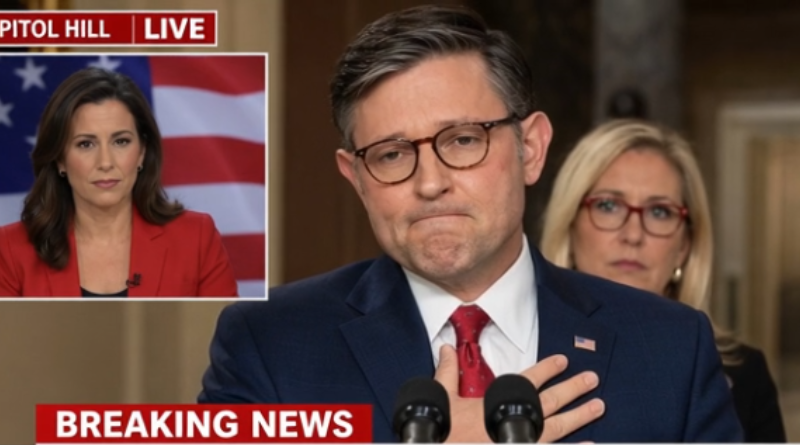
House Speaker Mike Johnson (R-La.) unveiled a new procedural strategy this week aimed at increasing pressure on the Senate to take up the SAVE America Act by tying the election integrity measure to the must-pass National Defense Authorization Act (NDAA).
The move follows days of tension within the House Republican conference, where several conservative lawmakers stalled routine legislative business while demanding stronger action on the SAVE America Act, which the House approved in February. The legislation would require individuals to provide proof of U.S. citizenship when registering to vote in federal elections and present photo identification when casting ballots.
Speaking with reporters Monday, Johnson explained that House Republicans intend to use a parliamentary tactic known as “MIRVing,” or merging legislation onto a single rule governing floor debate.
“We’re going to pass a MIRV, or what’s better known as a merge onto the rule,” Johnson said. “When Republicans vote for the rule, they’ll be voting not just for the NDAA and everything else that’s there, but they’ll be voting to merge onto that the SAVE America Act we passed back in February.”
If successful, the strategy would send both the NDAA and the SAVE America Act to the Senate together, signaling House Republicans’ commitment to advancing election security legislation alongside annual defense priorities. Johnson argued that opposing the procedural rule would effectively block progress on both measures.
The proposal, however, faces significant hurdles. Senate lawmakers could remove the election provisions while considering the NDAA, and combining the bills could complicate or delay passage of the annual defense authorization legislation.
Some Republicans remain skeptical. Rep. Anna Paulina Luna (R-Fla.) criticized the approach, arguing that simply attaching the SAVE America Act to the NDAA would still allow the Senate to strip it out. She urged House leaders instead to incorporate the election language directly into the defense bill through formal amendments, saying the proposal reflects the views of a large majority of Americans.
Other lawmakers expressed varying levels of support. Rep. Tim Burchett (R-Tenn.) said he wants to review the legislative language before deciding whether to back the plan, while House Freedom Caucus Chairman Andy Harris (R-Md.) said he supports efforts to move the bill forward.
Democrats continue to oppose the SAVE America Act, arguing that its requirements could create unnecessary obstacles for eligible voters. Republicans counter that the legislation is intended to strengthen election integrity by ensuring only U.S. citizens participate in federal elections. The House-passed version does not include additional restrictions on mail-in voting, a policy that President Donald Trump has publicly supported.
Johnson’s strategy highlights continuing divisions within the Republican conference over how aggressively to use must-pass legislation to advance broader policy goals. As negotiations continue, both the NDAA and the SAVE America Act face an uncertain path in the Senate.