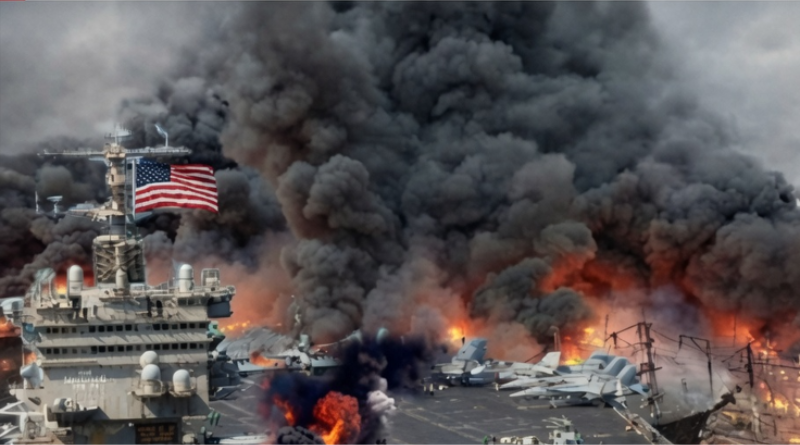
A dramatic fictional scenario explores what could happen if a U.S. aircraft carrier came under a sophisticated missile attack in the Arabian Sea. The story begins on a seemingly calm morning that is suddenly interrupted by missile warning alarms as eight Iranian missiles are launched toward the USS Gerald R. Ford, one of the most advanced warships in the world.
According to the scenario, seven of the missiles are highly advanced decoys designed to confuse defensive systems. Hidden among them is a single Khorramshahr missile carrying a massive 1,500-kilogram high-explosive warhead. The deception creates a complex challenge for the carrier’s defense network, forcing operators to quickly determine which target poses the greatest threat.
As the missiles close in, the ship’s Aegis Combat System responds immediately, launching interceptor missiles to destroy the incoming threats. The engagement becomes increasingly intense as the defensive missiles are expended one after another. Tension reaches its peak when the interceptor inventory is exhausted while two incoming missiles remain in the sky.
Amid the crisis, Lieutenant Rachel Webb notices a subtle irregularity in the exhaust plume of one missile. The difference is extremely small—just 0.3 percent—but her training and attention to detail convince her that it could identify the genuine warhead hidden among the decoys. While senior officers focus on broader operational concerns, Webb remains fixed on tracking the suspicious target.
The fictional encounter highlights the growing complexity of modern naval warfare. It demonstrates how advanced missile technologies, including decoys and deception tactics, can challenge even the most sophisticated defense systems. The scenario also emphasizes the importance of human judgment, showing how a single observation may prove as valuable as cutting-edge technology.
Although entirely hypothetical, the story raises important questions about future military conflicts, the evolution of missile defenses, and the constant need for innovation and readiness in an increasingly complex security environment.