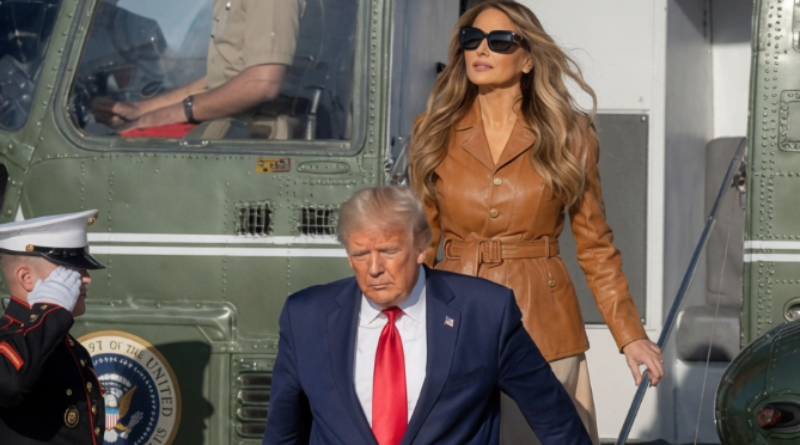
President Donald Trump’s second state visit to the United Kingdom briefly encountered an unexpected challenge when the Marine One helicopter carrying Trump and First Lady Melania Trump was forced to make a precautionary emergency landing. According to White House Press Secretary Karoline Leavitt, the aircraft experienced a hydraulic system issue while traveling to Stansted Airport. As a safety measure, the helicopter diverted to a nearby airfield, where the President and First Lady transferred to a backup aircraft. Although the original journey was expected to take about 20 minutes, the diversion extended the trip to roughly 40 minutes before the couple safely resumed their schedule.
Despite the transportation delay, the visit remained focused on strengthening the long-standing relationship between the United States and the United Kingdom. A key outcome was the announcement of a new “tech-prosperity deal” designed to expand cooperation in science and emerging technologies. The agreement seeks to encourage investment and collaboration in strategic sectors, including artificial intelligence, quantum computing, and future-generation 6G communications.
President Trump described the agreement as a major economic achievement, stating that it has already inspired more than $350 billion in private-sector commitments. Among the largest announced investments was a reported $136 billion commitment from Blackstone. Trump also praised Britain’s aerospace manufacturing capabilities, saying closer cooperation would strengthen supply chains and provide American companies with greater access to advanced production resources.
Energy innovation formed another major pillar of the visit. Trump and British Prime Minister Keir Starmer announced a partnership between American nuclear technology company X-energy and British energy firm Centrica. The project aims to deploy advanced modular nuclear reactors across the United Kingdom, with officials projecting approximately $50 billion in long-term economic benefits while generating enough electricity to power around 1.5 million homes.
Trump argued that expanding reliable nuclear energy is becoming increasingly important as artificial intelligence systems demand ever-growing amounts of electricity. He emphasized that maintaining leadership in AI requires parallel investments in modern energy infrastructure. Referring to technology leaders such as Jensen Huang, Trump said future innovation depends on ensuring abundant, dependable power supplies capable of supporting next-generation computing.
The President also promoted a policy approach centered on reducing regulatory barriers while encouraging technological innovation. He argued that streamlined regulations would accelerate progress in advanced nuclear energy, fusion research, and other high-tech industries. Concluding the visit, Trump invoked the legacy of British mathematician and computing pioneer Alan Turing, saying the new partnership would help ensure that the United States and the United Kingdom remain global leaders in technological innovation. After completing official meetings, business events, and diplomatic engagements, President Trump returned to the White House on Friday.